The New Science of the Trades.
What skilled work actually involves — and where it is going.
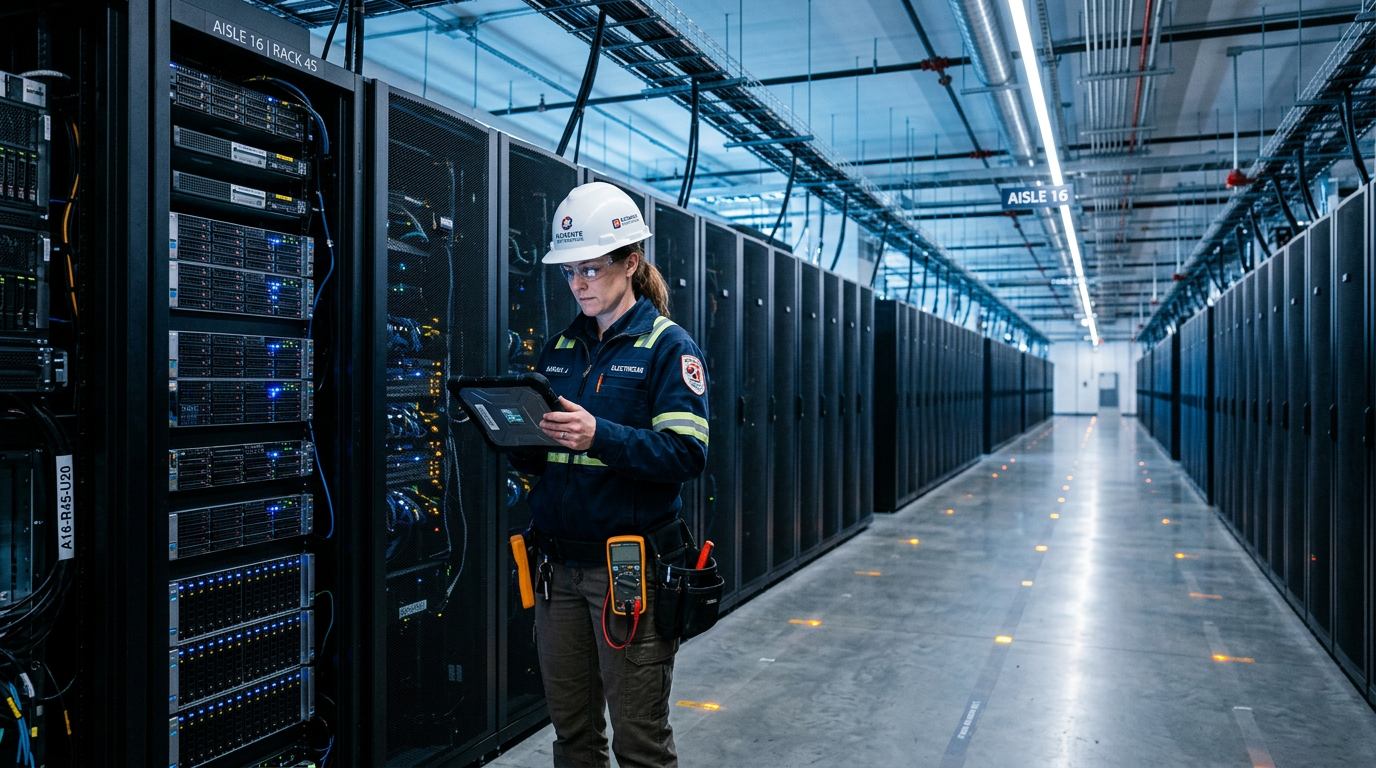
When people picture a career in the skilled trades, they rarely picture a technician managing the thermal dynamics of a liquid-cooled AI data center, or a manufacturing specialist programming collaborative robots on a factory floor, or an electrician designing microgrid integration systems for a hyperscale facility the size of a small city.
They should. And they will. The science was never in the job title. It's in the training — and the training has never had to carry more.
THE MOMENT
Three forces are rewriting the American economy at the same time.
AI is reshaping what white-collar work looks like, and how secure it feels. The four-year degree is losing its monopoly on middle-class mobility. And the physical infrastructure of the AI era — data centers, power generation, advanced manufacturing, the grid itself — is being built right now, at a scale the country has not attempted in generations.
These shifts are converging on a single workforce question: who builds, powers, and maintains the infrastructure AI requires?
The answer is already visible on job sites, in hiring specifications, and in the salary premiums being paid to workers who command the science inside their trades. The skilled workforce that has always anchored the American economy is now the workforce the next economy cannot be built without.
The public story we tell about these careers has not caught up.
The largest buildout in human history needs the most undervalued workforce in America.
Skilled work has always been science work. A welder works in metallurgy and electrochemistry; a plumber in fluid dynamics and hydraulics; a process technician in thermodynamics and reaction chemistry; an electrician in physics and power systems. What the public picture has never caught is that this is learned science — installed through education, training and apprenticeship, sharpened over years on the job, and carried in the skills and judgment of the worker.
What is new is how much more of it the job now demands — and how far that reality has outrun the story America still tells about these careers.
The CEO of NVIDIA said it plainly:
"This is becoming the largest infrastructure buildout in human history. The labor required to support this buildout is enormous. AI factories need electricians, plumbers, pipefitters, steelworkers, network technicians, installers and operators. These are skilled, well-paid jobs, and they are in short supply. You do not need a PhD in computer science to participate in this transformation."
— Jensen Huang, CEO, NVIDIA, March 10, 2026
Science Mapping
Five trades. Five scientific frontiers. One convergence point.
What follows is a mapping of the applied science inside five of the most economically critical skilled trades — the scientific foundation of each field today, and the new technical demands entering each as AI infrastructure, energy systems, and advanced manufacturing reshape the American economy.
It is also a map of what a serious CTE program now has to teach — the applied-science education behind every worker who can command this.
These are not projections. The science described here is already present on job sites, in hiring specifications, and in the salary premiums being paid to workers who command it.
Electricians have always worked at the intersection of physics and engineering. What's changing is the scale and complexity of the systems they're being asked to build. The hyperscale AI data center is not a larger version of a commercial building — it is a fundamentally different kind of electrical environment, one that requires command of sciences that weren't part of the trade a decade ago.
- Alternating current theory and circuit analysis
- Three-phase power distribution
- NEC code and load calculations
- Residential and commercial wiring systems
- Basic transformer and motor theory
- High-voltage direct current (HVDC) architecture
- Solid-state transformer technology
- Microgrid integration and grid stabilization
- Intelligent power distribution and real-time monitoring
- Battery and UPS systems including lithium-ion topology
- Generator synchronization for hyperscale loads
HVAC has always been applied thermodynamics — the science of moving heat from where it is unwanted to where it can be safely released. AI infrastructure has pushed that science into territory that bears almost no resemblance to traditional air conditioning. Today's GPU-class processors often operate at or above 1,000 watts per unit, and at rack densities of 40–100 kW, air cooling becomes impractical — liquid cooling is now the primary method for safely and efficiently removing heat at these densities.
- Refrigeration cycle thermodynamics
- Airflow dynamics and pressure management
- Heat transfer — conduction, convection, radiation
- Refrigerant chemistry and EPA compliance
- Residential and commercial air systems
- Direct-to-chip liquid cooling installation and maintenance
- Immersion cooling and dielectric fluid chemistry
- Hydraulic and fluid system engineering
- Coolant Distribution Unit (CDU) operation
- Thermal load modeling for 40–100kW rack densities
- Computational fluid dynamics fundamentals
- AI-driven thermal monitoring systems
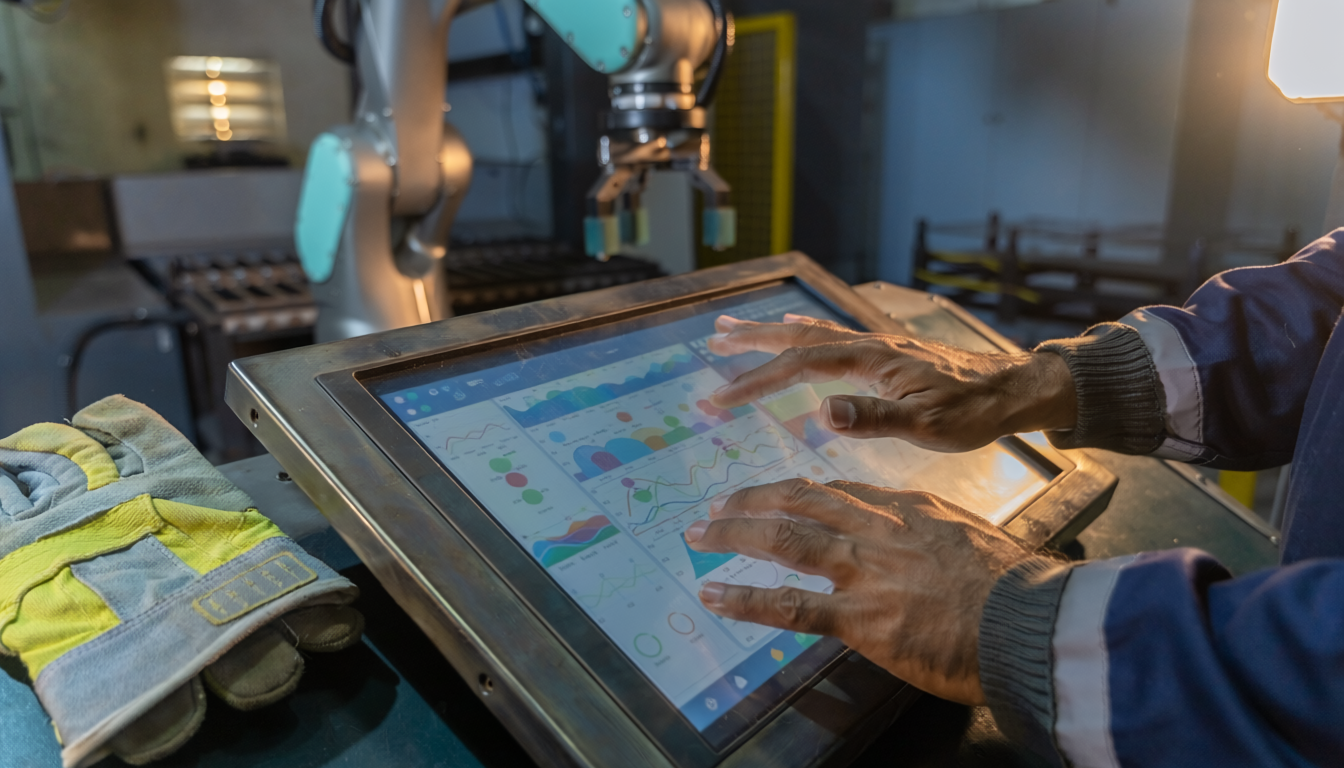
Advanced manufacturing has been science-intensive for decades — but the science has changed. The factory floor of 2028 is an integrated digital environment where mechanical systems, software, sensors, and human judgment interact in real time. The worker who thrives in that environment is not simply more skilled — they are differently skilled, with fluency in mechatronics, robotics, industrial IoT, data, and automation that didn't exist as trades training a generation ago.
- CNC machining and precision measurement
- Metallurgy and materials properties
- Welding science — MIG, TIG, arc
- Basic PLC programming and automation
- CAD/CAM fundamentals
- Statistical process control
- Collaborative robotics — programming and integration
- Industrial IoT sensor networks and data acquisition
- Digital twin technology and simulation
- AI-assisted quality control and computer vision
- Mechatronics — integrated electrical, mechanical, and software systems
- Predictive maintenance algorithms
- Additive manufacturing for complex geometries
Construction has always embedded science — structural physics, materials chemistry, soil mechanics, hydraulics. What has changed is the digital layer now running through every major project. Building Information Modeling has shifted coordination from fragmented paper workflows to integrated, data-driven collaboration. Workers who thrive in that environment need fluency across BIM, MEP coordination, site data, and digital construction systems.
- Structural physics and load distribution
- Materials science — concrete, steel, wood, composites
- Soil mechanics and site preparation
- Hydraulics for plumbing and drainage
- Electrical fundamentals for MEP rough-in
- Blueprint reading and 2D plan interpretation
- Building Information Modeling — 3D MEP coordination
- Drone photogrammetry and scan-to-BIM workflows
- Augmented reality for real-time site overlay
- Advanced composites and engineered materials
- Carbon measurement and sustainability compliance
- Integrated MEP systems as unified digital infrastructure
Plumbing and piping are applied fluid mechanics — the science of moving liquids safely, efficiently, and precisely through designed systems. AI infrastructure has added a new class of closed-loop coolant circuits in data centers, where liquid cooling handles rack-level heat loads far higher than typical building systems. Specialized plumbing and piping technicians working on these systems operate at the intersection of hydraulics, materials science, and precision instrumentation.
- Fluid mechanics and hydraulic principles
- Drain-waste-vent system design
- Water supply pressure and flow calculations
- Pipe materials science — copper, PVC, PEX
- Soldering, brazing, and joining chemistry
- Uniform Plumbing Code
- Precision coolant loop installation for data centers
- Closed-loop glycol and dielectric fluid systems
- Pressure differential monitoring and sensor integration
- High-purity water treatment for immersion cooling
- Leak detection science and instrumentation
- Cross-disciplinary MEP coordination
WHERE TO BEGIN
These careers are accessible. The path in is closer than most people think.
What this page describes is applied-science education — and its laboratory is the real world. A student entering these fields is a science student whose lab happens to be a data center floor or a fabrication shop instead of a lecture hall. And you don't have to have chosen it at seventeen. These are fields with structured, paid entry points at any stage — career-changers from other industries, veterans whose military training already contains more applied science than most people recognize, people reconsidering a path they started somewhere else entirely, and recent high school graduates alike.
How most of these careers begin today
The most common entry point is a single course — or a short certificate program — at a local community college. Community colleges offer CTE programs in every trade profiled here, typically at low or no cost through workforce development funding. Many programs connect students directly to paid apprenticeships that allow them to earn while they develop skills. In most trades, a person who begins a community college CTE program today can be working — and earning — within a year.
Apprenticeships in the electrical and HVAC trades pay from the first day of training. An apprenticeship is a paid residency — supervised scientific practice, the way a medical resident practices medicine before they're board-certified. A first-year electrical apprentice typically earns 40–50% of journeyman wages while learning. By the end of a four or five-year apprenticeship, they are earning full journeyman scale — often between $70,000 and $100,000 — with no student debt.
The trades profiled here are not backup plans. They are a front-door entry into some of the most scientifically demanding, economically secure, and hardest-to-automate work in the American economy — because the science lives in the worker's judgment, not just the task.
To find CTE programs at community colleges in your area, visit careeronestop.org or contact your state's community college system directly. The Association for Career and Technical Education (ACTE) and Advance CTE are additional resources for understanding program options and pathways.
BEHIND THIS WORK
A founding circle of industries, building the narrative their workforce deserves.
The science mapping on this page is the product of a first-of-its-kind collaboration: trade associations, major employers, and workforce investors speaking together about the skilled workforce the next economy depends on.
The CTE Science Alliance is currently assembling its Founding Circle — the trade associations, major employers, and workforce investors who have the most to gain from reshaping how America talks about skilled work, and who see that the story is bigger than any one sector can tell.
Founding Circle members help define which trades we map, which communities we reach, and who is in the rooms where the agenda is shaped. They gain a seat in the only permanent, multi-industry alliance built specifically to change how K-12 students, their families, and their communities see the science inside skilled work — before the career decision is made.