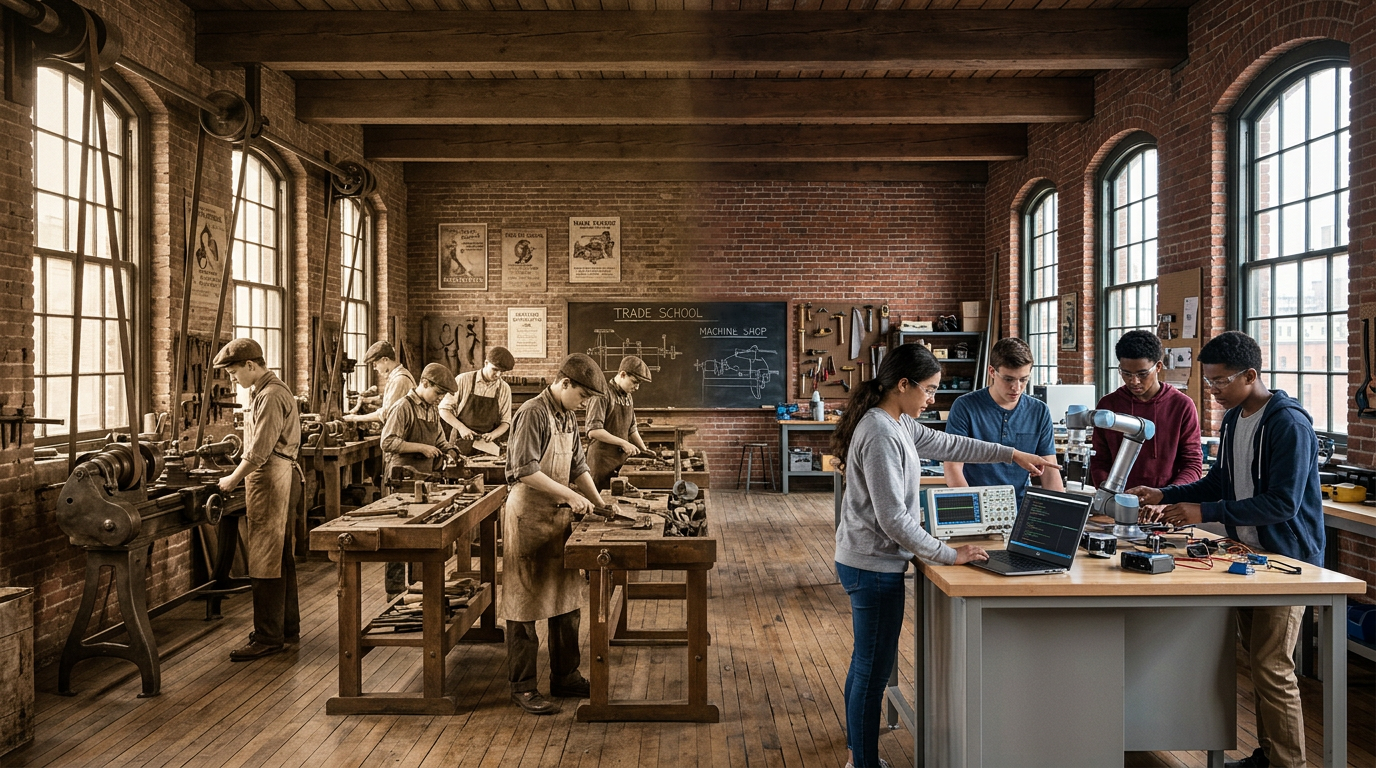
Why we exist.
What happens to a born scientist?
Every child starts as a scientist. Curiosity drives them to guess, take chances, get it wrong, and go again — running the scientific method before anyone's taught it to them.
Then, somewhere along the way, the questions stop. A mistake is no longer a clue. It's a mark on a permanent record.
The questions didn’t stop on their own. Someone stopped them.
THE WALL

The line that runs through American schools.
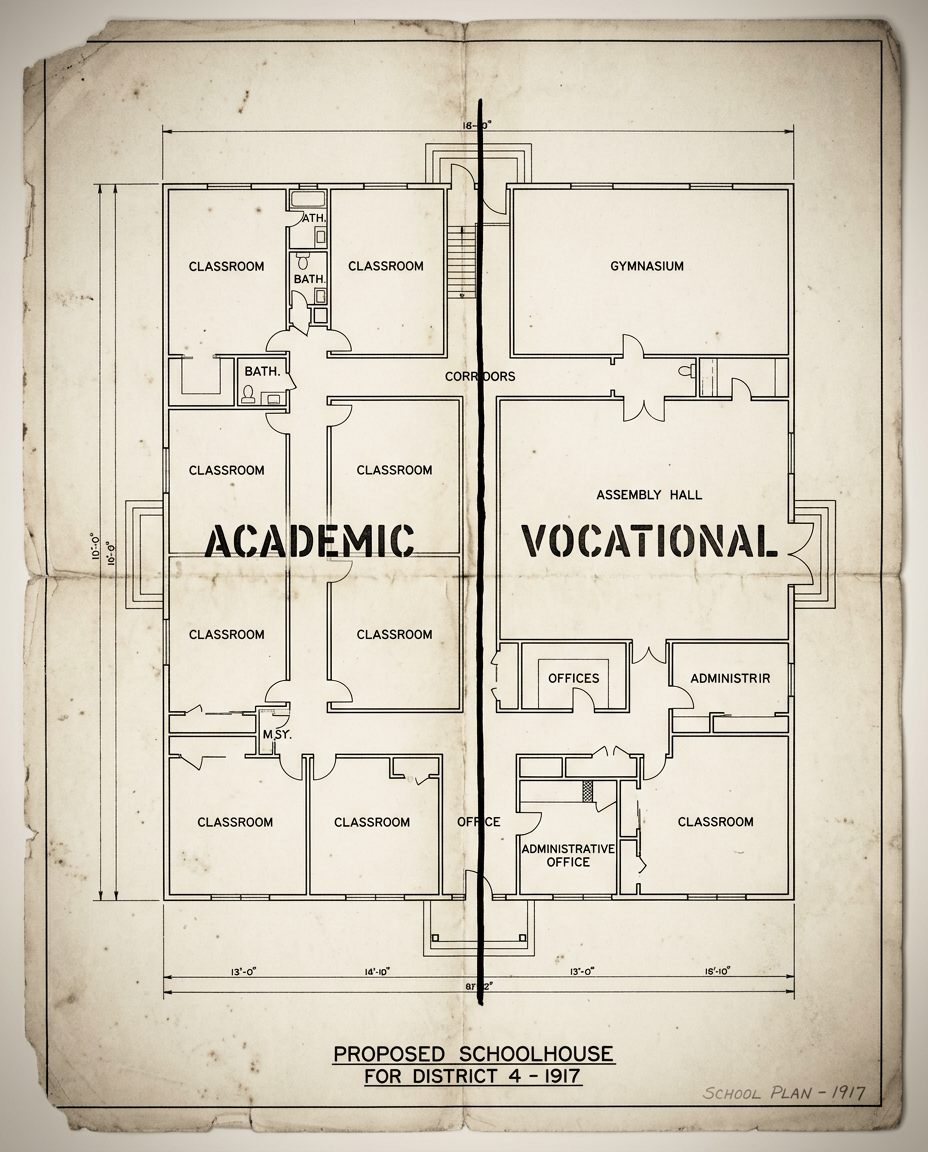
The separation between "book learning" and "working with your hands" was written into federal law in 1917. That year, the Smith-Hughes Act created the first federal money for vocational education. It built the trades a world apart: their own classrooms, their own teachers, their own funding, their own authorities.
Two tracks, drawn before a kid was old enough to choose. One was called thinking. The other was called work. The words are softer now: "college material" — "good with their hands." The sorting isn't.
For the industrial economy of the twentieth century, that was the point. It needed some hands trained to think, and many more trained to do as they were told. And the wall delivered exactly that.
THE OBJECTION
It was contested the moment it was drawn.
The country was warned. Two years before the wall went up, John Dewey, the most influential thinker on education this country has produced, argued against precisely this design. Splitting the schools in two, he wrote, one track for "traditional methods" and another "for those who are to go into manual labor," amounted to "a plan of social predestination totally foreign to the spirit of a democracy.”
He lost the argument. The wall went up anyway, and it has stood for more than a century.
Which is the part worth holding onto. The divide was never a verdict on anyone's ability, and it was never any teacher's doing. It was a structure — chosen, funded, and built into the system before most of today's students' great-grandparents were born.
THE INHERITANCE
The sorting left something behind.
Do that for a century, and it stops looking like a choice and starts feeling like the natural order of things. We took a nation of natural scientists and, over generations, sorted the ones we labeled "thinkers" into offices, and everyone else into a lesser tier.
The residue is a belief, absorbed young, rarely questioned: that working with your hands means you weren't smart enough for the other thing. And that belief, not wages and not demand, is the barrier now. Both of those point the other way.
The Inheritance
A hundred-year-old prejudice that still whispers to a capable kid that what they can do with their hands doesn't count as science.
THE SECOND ACT
After the war, the wall got taller.
The story didn't stop in 1917. After the Second World War, the country threw open the doors to college. The GI Bill alone put it within reach of millions who'd never have gotten near it. Generous, real, overdue. But somewhere in the celebration, college stopped being a good path and became the only one that counted. The old separation didn't fade; it got dressed in the language of ambition, and the trades were quietly recast from an honorable choice into the thing you settled for. The wall of 1917 didn't come down after the war. It got taller.
WHY WE EXIST
That's the story we’re here to change.
The wall is more than a hundred years old, and the economy that built it is gone. The industrial century that needed some kids to think and others to obey has given way to one where the science is in the skilled work. And the country that spent generations looking past those hands now can't build the future without them.
The CTE Science Alliance exists to tear that wall down: to make the science inside skilled work impossible to miss, and to change what students, parents, and communities see when they look at the people who build, power, and maintain the country.